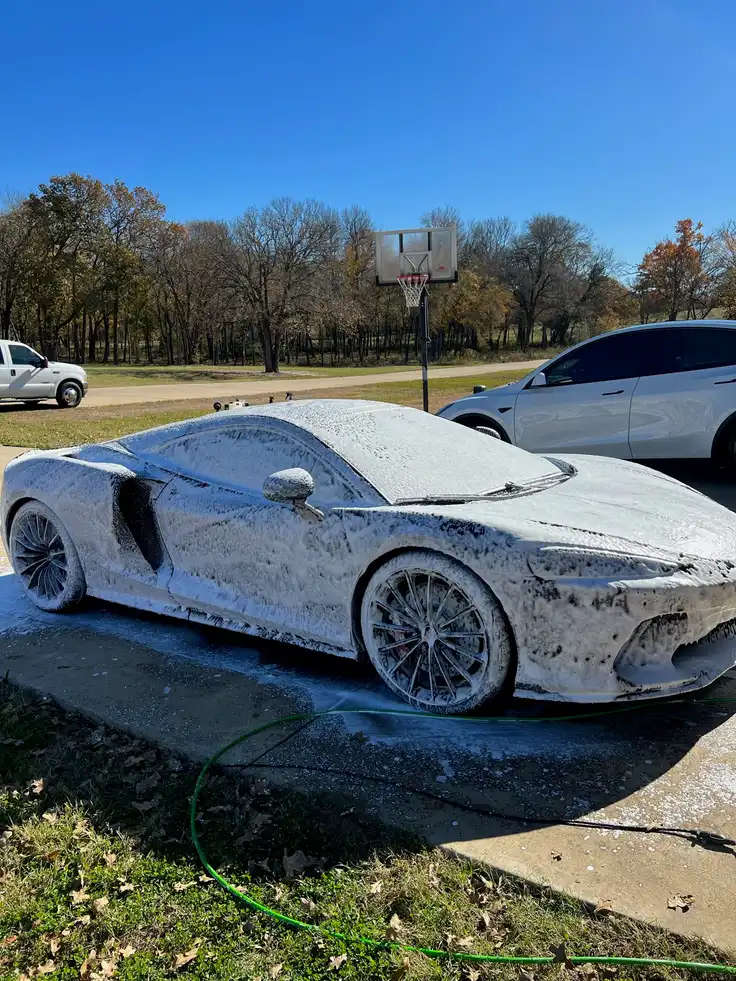
10 Auto Detailing Tips for North Texas Drivers (Heat, Dust, Pollen, and Hard Water)
North Texas puts a specific kind of stress on a vehicle. Summers run past 100°F for weeks. Spring brings pollen heavy enough to turn a black hood yellow overnight. Country roads throw fine red-clay dust into every panel gap. Sprinkler overspray etches hard-water mineral deposits into clear coat by August. None of that is avoidable — but most of it is manageable with a small set of habits that compound over the life of the vehicle.
This is an educational checklist. No fixed frequency applies to every car — a garaged daily driver in Kaufman will need less than a weekend truck in Forney — but the principles below apply to every vehicle on Texas roads.
1. Never Wipe a Dry Dusty Vehicle
This is the single biggest cause of swirl marks on North Texas paint. Fine red-clay dust and limestone dust are mildly abrasive. Dragging a towel across a dry, dusty panel grinds those particles into the clear coat exactly like low-grit sandpaper would. If you are going to touch paint, rinse first — ideally with a pressure washer or at minimum a garden hose — before any microfiber comes into contact with the surface.
2. Rinse After Country-Road Drives
Red-clay dust and limestone dust bond into paint faster than most other contaminants. If you have been on gravel or county roads, a quick rinse (no soap, no wiping) within 24 hours prevents most of that bonding. Even 30 seconds with a hose meaningfully reduces how hard the dust is to remove on your next full wash.
3. Use the Two-Bucket Method
One bucket for wash solution, one for rinsing the wash mitt between passes. This keeps most of the grit that comes off the vehicle out of the wash bucket — which is the grit that ends up dragged across your next panel and creates swirls. A grit guard in the rinse bucket is another $10 upgrade that dramatically improves results. Both are standard tools at any detail shop; they cost almost nothing and change outcomes more than any single wash product. Before you wash in the driveway, though, check whether your HOA restricts driveway car washing — a number of North Texas communities do, especially newer master-planned subdivisions.
4. Park in the Shade Whenever Possible
UV is the primary enemy of automotive paint in Texas. Direct sun exposure breaks down clear-coat polymers, fades rubber and plastic trim, and bakes interior surfaces into heat-cycled off-gassing and eventual cracking. A shaded parking spot, carport, or garage adds years to your vehicle’s appearance. If permanent shade is not available, a basic sunshade on the windshield prevents the worst of the dashboard and steering-wheel degradation. And if your trim has already faded to chalky gray, shade only stops the bleeding — bringing the black back is its own project, covered in how to restore black plastic trim.
5. Address Bug Splatter and Bird Droppings Within 24 Hours
Bug splatter, bird droppings, and tree sap all etch into clear coat quickly in Texas heat — sometimes within hours on a hot day. If you are looking up how to remove bugs from your car, the real answer is speed: a spray detailer or a dedicated bug and tar remover with a clean microfiber towel within 24 hours of deposit removes all of them without any real paint damage. Spring highway drives load a front bumper fast, and a quick pass the same evening beats a scrubbing session a month later. Leave them a week in August and they etch into the clear coat in a permanent way that only paint correction can fix.
6. Clean Wheels Before They Cool
Brake dust is iron, and iron bonds to wheels chemically — not just physically — as the wheel heats during driving and cools afterwards. Cleaning wheels before they have fully cooled makes brake-dust removal significantly easier and prevents the long-term pitting that can show up on untreated aluminum and painted wheels. Cool to the touch is warm enough. Don’t clean a wheel immediately after freeway driving — let it drop from scalding to just warm first.
7. Condition Leather Twice a Year
Leather seats in Texas vehicles crack from the combination of UV exposure and heat-driven moisture loss. A twice-a-year cleaning and conditioning cycle — ideally at the start of summer and the start of winter — keeps the leather supple and prevents the surface cracking that typically appears around year five to seven on untreated seats. Use a pH-balanced leather cleaner (not all-purpose cleaner) followed by a conditioner with UV-protective ingredients.
8. Dry Interior Carpet Completely After Any Wet Event
Whether it is a spilled drink, a rainy entry with soaked shoes, or a steam-extraction cleaning, wet carpet in a sealed Texas cabin grows mildew and odor fast. Fans, open doors, and dry microfibers help. A wet-dry vacuum over the wet area pulls most of the moisture out. Avoid the mistake of closing the doors on damp carpet and letting the car sit in the sun — that is exactly how the worst interior odors start. And if damp carpet has already turned into visible spots, see our guide on how to remove mold from a car interior before sealing the car back up.
9. Watch for Sprinkler Overspray on Parked Vehicles
Sprinkler overspray deposits dissolved minerals onto paint every time it hits the vehicle, and those minerals etch into clear coat as the water evaporates in Texas heat. The white dots you see on a car parked next to a sprinkler-irrigated lawn are water-spot etching. Move the vehicle if you can. If you cannot, plan on a clay-bar decontamination and potentially paint correction every year to stay ahead of the etching.
10. Understand What Wax, Sealant, and Ceramic Coating Actually Do
Protection is layered. Wax lasts weeks to a few months, beads water, and needs constant reapplication. Polymer sealant lasts three to six months and resists chemicals better than wax. Ceramic coating lasts two to three years, bonds to the clear coat at a molecular level, and offers UV, hydrophobic, and chemical protection that wax simply cannot match. Choose the layer that matches how much maintenance you are willing to do — and how much you care about the paint over the long term.
How to Detail a Truck in Texas
Trucks concentrate every problem on this list at once: more panel surface, deeper wheel wells, bed liners that trap abrasive dust, and — for work trucks — mud and limestone loads a sedan never sees. The order of operations matters more than the products. Pre-soak mud and red clay at low pressure so it releases before anything touches the paint, blow out and flush the wheel wells before washing the body so runoff doesn’t re-contaminate clean panels, then run the same two-bucket wash from tip 3 with one change: rinse the mitt twice as often, because a truck sheds two sedans’ worth of grit.
The bed decides whether the job holds up. Scrub spray-in liners with a stiff brush and a degreaser — a plain rinse just relocates the grit — and pull drop-in liners where you can, since trapped moisture underneath is where bed-seam corrosion starts. Finish with a sealant coat on everything, bed paint included; unprotected horizontal truck surfaces chalk faster under Texas sun than any other panel. And if the truck earns its keep on county roads or jobsites, that workload is exactly what our truck detailing in Kaufman County package is built for.
Frequently Asked Questions
What is the safest way to remove bugs from paint?
Soak the affected area with a bug and tar remover or a detail spray for one to two minutes, then wipe gently with a clean microfiber — that soak-and-wipe cycle is how to clean bugs off your car without marring the finish. Never scrub dry bugs off dry paint: the acidity and dried proteins etch into clear coat quickly in Texas heat, and scrubbing grinds them into the surface. If the splatter has already dried hard, repeat the soak instead of adding pressure.
How do I maintain ceramic coating between professional appointments?
Use a ceramic-specific maintenance wash shampoo and avoid all-in-one cleaners that contain wax, sealant, or polishing compounds — those additives can degrade the coating’s hydrophobic performance. Never use automatic brush washes. A ceramic-specific detail spray after a wash extends beading and gloss. An annual professional booster coat significantly extends the life of the original coating.
How often should I clay-bar my vehicle?
Once or twice a year for most North Texas vehicles, and whenever the paint feels gritty to the touch after washing. Clay removes bonded contamination that washing cannot — iron fallout, tar, tree sap, limestone — and is the step that restores the smooth feel of new paint.
Is waterless wash safe for my paint?
Only if the vehicle is lightly dusty. Waterless wash products use polymers to encapsulate dirt so it lifts off cleanly on a clean microfiber. On heavily soiled vehicles, they are not enough — that grit is still abrasive and dragging a towel through it still causes swirl marks. For country roads or after a dust storm, a proper rinse and two-bucket wash is the right tool.
If you’d rather hand any of this work off to a professional, Bridges Mobile Detailing is based in Kaufman, TX. The full detail package, exterior detail, interior detail, and ceramic coating services all come to your driveway across Kaufman County.
Rather skip the DIY and have this handled at your driveway? Bridges covers Kaufman County, Rockwall County, and the surrounding North Texas area. View the full service menu and pricing or book online in about two minutes.
More from the
journal.
DIY Ceramic Coating vs Professional: What Kits Get Right (and Wrong)
DIY ceramic coating vs professional: a Kaufman County mobile installer breaks down what kits get right, where driveway…
Read article →How to Remove Mold From a Car Interior (and When to Call a Pro)
Found mold in your car? Here's how to remove mold from a car interior step by step — fix the moisture, clean the surfac…
Read article →How to Get Weed Smell Out of a Car (What Works and What Doesn't)
Weed smell in a used car, rental return, or trade-in comes out with extraction and ozone — not sprays. The full removal…
Read article →PPF vs Ceramic Coating: An Honest Comparison From a Guy Who Only Sells One
PPF vs ceramic coating from a North Texas detailer who doesn't sell film — what each one protects against, real cost ra…
Read article →Toothpaste on Headlights: Does It Work? An Honest Answer
Toothpaste can clear a foggy headlight for a few weeks — then the haze comes back. Here is the abrasive mechanism, why…
Read article →Ceramic Coating Cost in 2026: What $399, $599, and $899 Actually Buy
Ceramic coating cost in 2026: Standard $399+, Premium $599+, Elite $899+ explained — warranties, Texas lifespan, and wh…
Read article →